Quantum Boundary Warfare: How TSMC’s A14 (1.4nm) Breaks the 1nm Wall and Unlocks the AI Holy Grail


TSMC’s A14 (1.4 nm) process is widely regarded as one of the “final frontiers” of semiconductor physics—and a critical technological “holy grail” underpinning the global AI era. As fabrication scales push into the angstrom regime, engineers are no longer merely optimizing materials; they are confronting the laws of quantum mechanics head-on. Scheduled for mass production around 2028, this technology aims to meet the explosive demand for AI compute while delivering substantial gains in performance and energy efficiency.

Below is a comprehensive, illustrated article integrating the latest official disclosures, technical analyses, and detailed mathematical models of quantum tunneling (based on public information such as TSMC’s 2025 North America Technology Symposium, as of early 2026):


1. The Physical Limit: Quantum Tunneling — The Challenge of the 1 nm Wall

At the 1.4 nm scale, the gate oxide (or high-k dielectric) thickness has shrunk to just a few atomic layers. According to quantum mechanics, electrons exhibit wave–particle duality. Even when their energy is lower than the potential barrier, there remains a finite probability that they can “pass through the wall”—a phenomenon known as quantum tunneling.
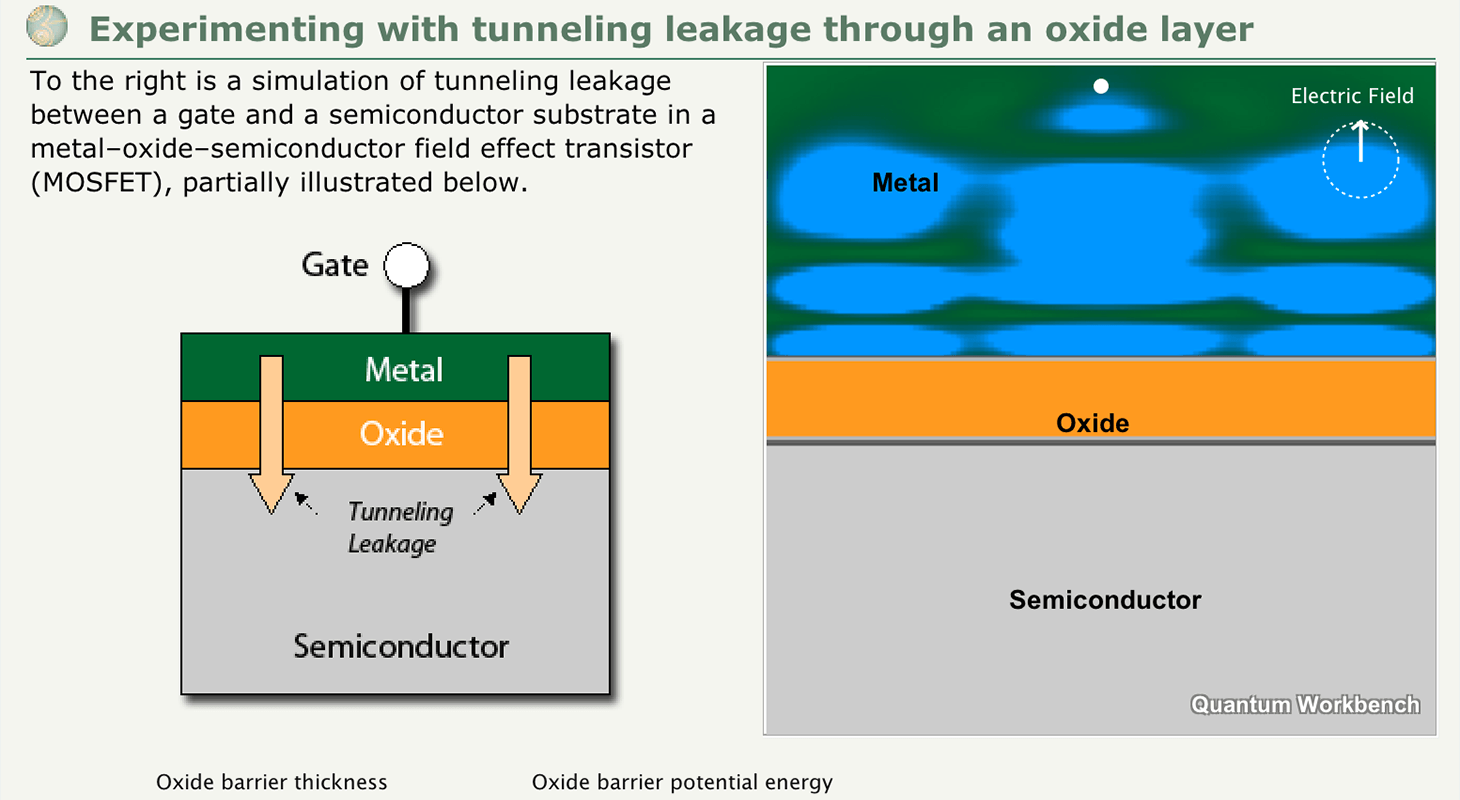

Phenomenon and Consequences: Leakage Driven by Quantum Tunneling

Quantum tunneling leads to severe leakage current. Even when a transistor is “off,” electrons can still tunnel through the barrier, causing uncontrolled power consumption and overheating. This is what the industry refers to as the “1 nm wall.” In traditional FinFET structures, this effect worsens exponentially as dimensions shrink. At the A14 node, where oxide thickness approaches the atomic scale, quantum effects become extremely pronounced.


Detailed Mathematical Model of Quantum Tunneling

Quantum tunneling is fundamentally described by the one-dimensional time-independent Schrödinger equation:

22md2Ψ(x)dx2+V(x)Ψ(x)=EΨ(x)-\frac{\hbar^2}{2m^*}\frac{d^2 \Psi(x)}

where

  • mm^* is the effective mass,
  • V(x)V(x) is the potential energy,
  • Ψ(x)\Psi(x) is the wavefunction.


Exponential Decay in the Classically Forbidden Region (E<V(x))(E < V(x))

κ(x)=12m[V(x)E]\kappa(x) = \frac{1}{\hbar}\sqrt{2m^*\,[V(x) - E]}


Tunneling Probability for a Rectangular Barrier

(when the barrier is sufficiently thick and high):

T16EV0(1EV0)exp(2βL)T \approx 16 \frac{E}{V_0}\left(1 - \frac{E}{V_0}\right)\exp(-2\beta L)

where

β=2m(V0E)\beta = \frac{\sqrt{2m^*(V_0 - E)}}{\hbar}

and LL is the barrier width (i.e., oxide thickness).


WKB Approximation (Widely Used in Semiconductors — Note)

Applicable to arbitrarily shaped, slowly varying potentials:

Texp(2γ),γ=x1x2κ(x)dx=1x1x22m[V(x)E]dxT \approx \exp(-2\gamma), \quad \gamma = \int_{x_1}^{x_2} \kappa(x)\,dx = \frac{1}{\hbar} \int_{x_1}^{x_2} \sqrt{2m^*[V(x)-E]} \, dx

The exponential term dominates the probability.
For ultra-thin oxides (< 2 nm), even a slight reduction in thickness LL causes a dramatic increase in TT, leading to an exponential rise in leakage current. This is precisely the “quantum boundary” that A14 must confront.


Tsu–Esaki Formula (Current Density in MOS Gate Leakage)

J0T(E)f(E)dEJ \propto \int_{0}^{\infty} T(E)\,f(E)\,dE

where

  • T(E)T(E) is calculated via WKB,
  • f(E)f(E) incorporates the Fermi–Dirac distribution and oxide voltage effects.


Fowler–Nordheim Tunneling

(high electric field, triangular barrier):

Texp(42mΦB3/23qE)T \propto \exp\left(-\frac{4\sqrt{2m^*}\,\Phi_B^{3/2}}{3\hbar q E}\right)

where

  • ΦB\Phi_B is the barrier height (≈ 3.1 eV for Si/SiO₂),
  • EE is the electric field.


These models enable TSMC to predict and suppress leakage. In A14, the adoption of GAA structures and high-k materials effectively increases the barrier height and reduces κ(x)\kappa(x), keeping tunneling probability T within acceptable limits.


2. Structural Evolution: 2nd-Generation GAA Nanosheets + Backside Power Delivery

To overcome the quantum boundary, TSMC is advancing the Gate-All-Around (GAA) architecture with second-generation nanosheet designs:

  • The gate fully surrounds the channel on all sides, dramatically improving electrostatic control and suppressing short-channel effects and quantum tunneling.
  • Compared to FinFETs (three-sided control), GAA offers superior switching behavior and leakage reduction.
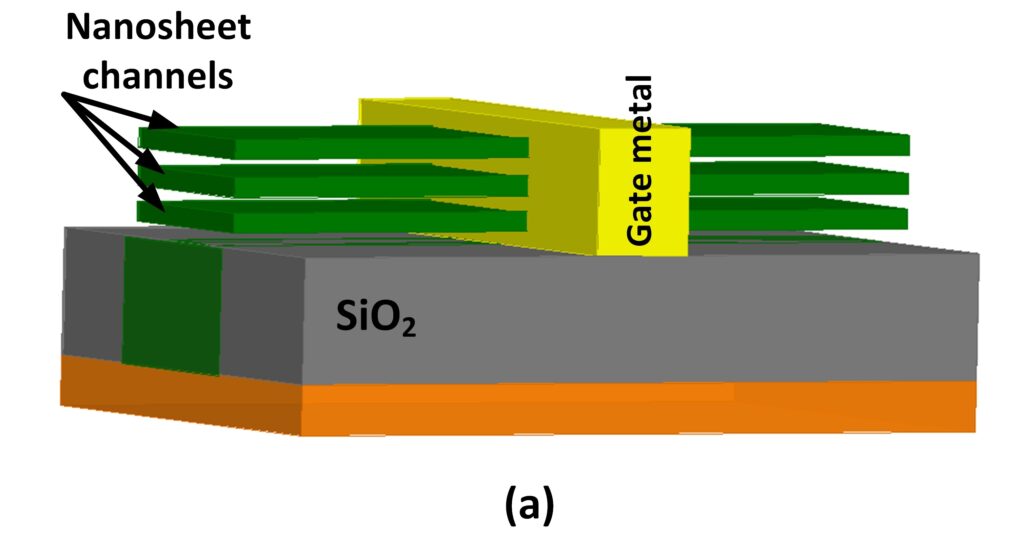
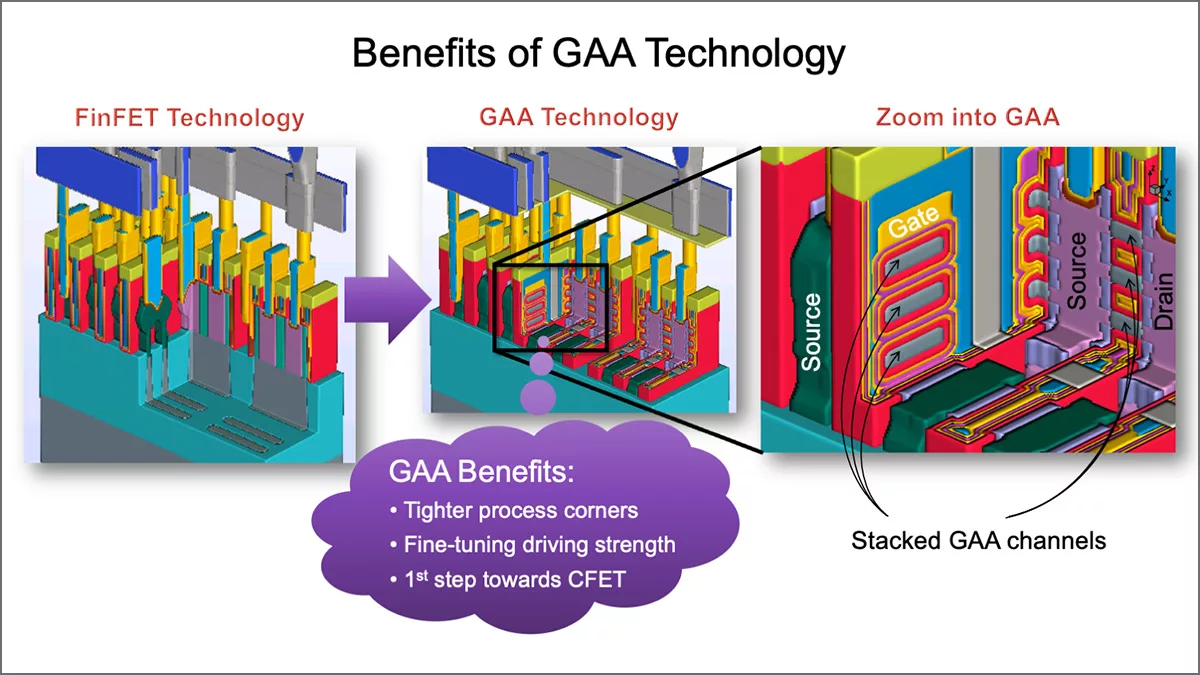
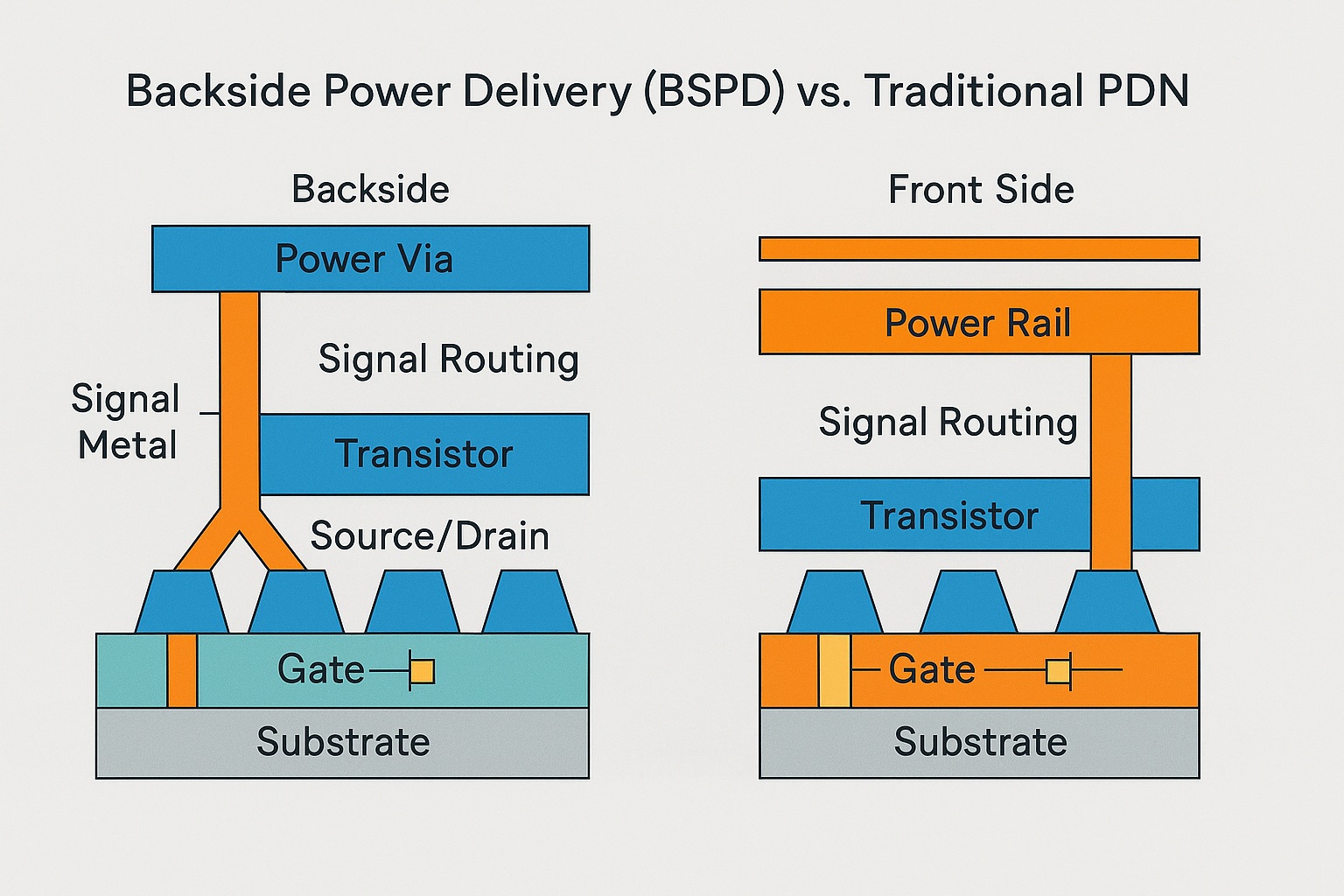
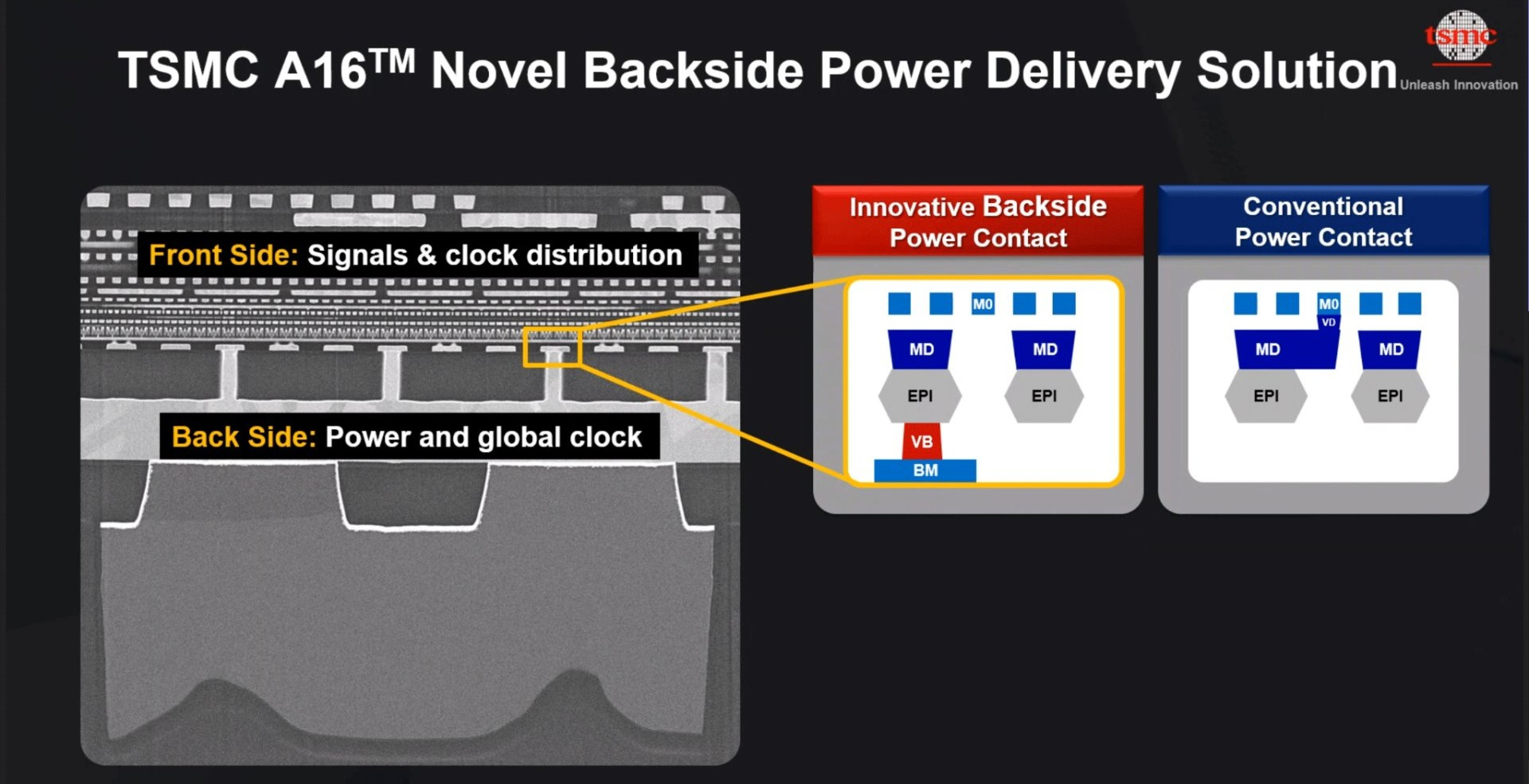
Vertical Power Delivery (Super Power Rail / Backside Power Delivery, BSPDN)

The baseline A14 node adopts a conventional frontside power delivery scheme. However, TSMC plans to introduce an advanced version—A14P—around 2029, integrating Super Power Rail technology.

This approach moves power routing to the backside of the chip, allowing the frontside to focus entirely on signal interconnects. The result is reduced electrical noise, lower IR drop, and further improvements in logic density.
3. Key Technical Metrics and Timeline of A14

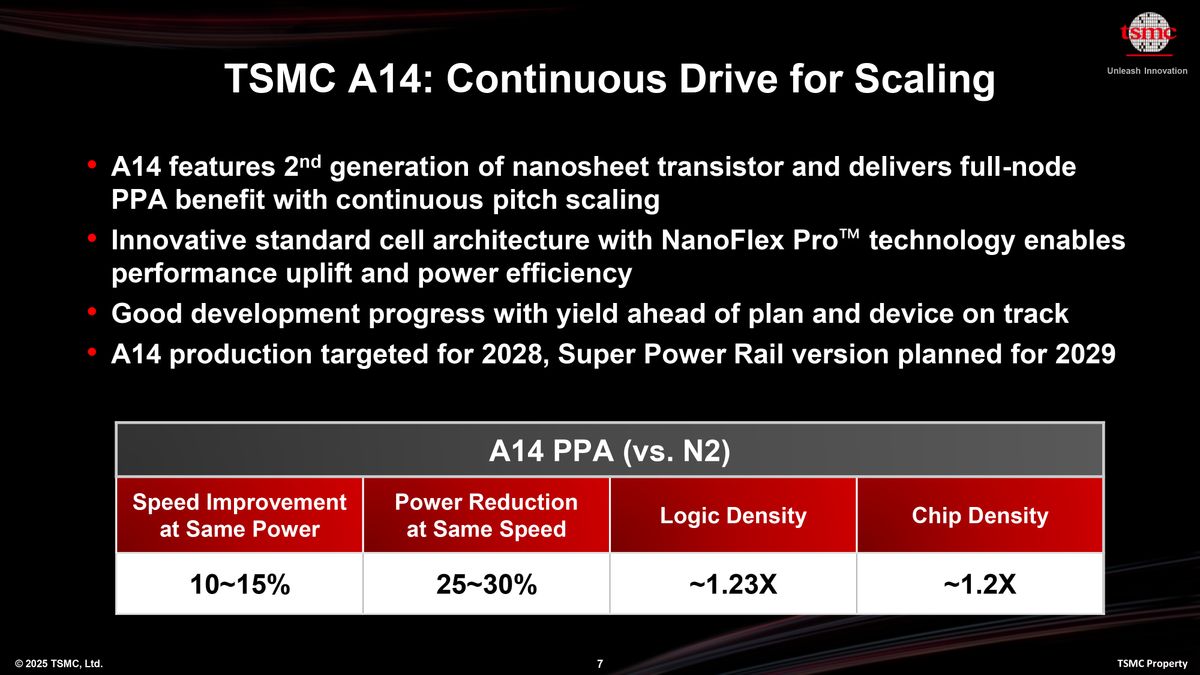
According to TSMC’s official data, A14 achieves a full-node improvement over the N2 (2 nm) process:

MetricImprovement vs. N2
Performance (Speed)+10–15% (at the same power)
Power Consumption−25–30% (at the same speed)
Logic Density~1.23× increase
Chip Density~1.2× increase

Timeline:

  • Late 2027: Risk production
  • 2028: Mass production (HVM)
  • 2029: Introduction of Super Power Rail (backside power delivery) variant

In addition, TSMC is introducing the NanoFlex Pro standard cell architecture, enhancing design flexibility and enabling further optimization of PPA (Power, Performance, Area).


4. Beyond Silicon: Exploration of Next-Generation Materials

The atomic spacing of silicon is approximately 0.5 nm, meaning that a 1.4 nm channel can accommodate only about three atoms across its width. At this scale, physical limits are rapidly being approached.

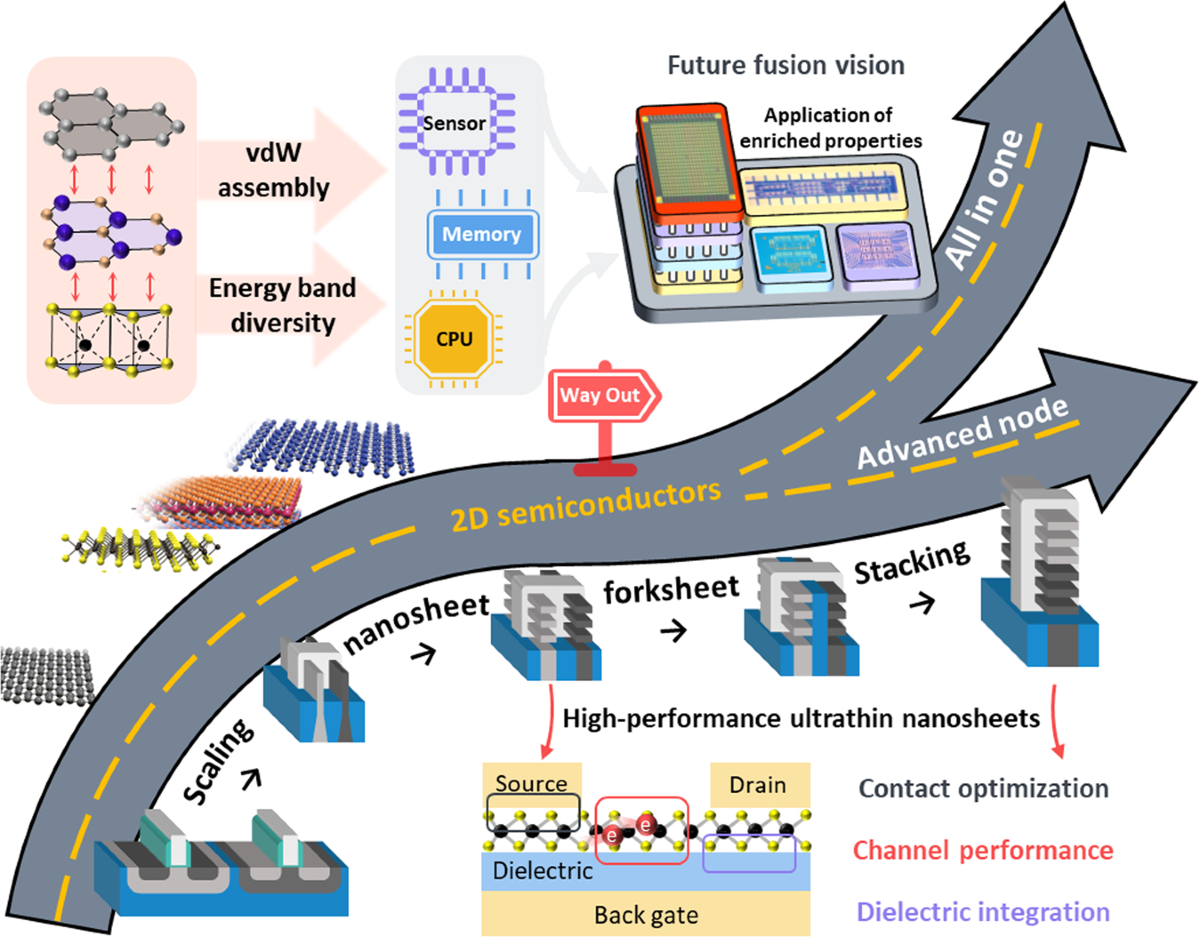
To address this, TSMC and the broader semiconductor industry are actively exploring post-silicon materials:

  • Two-dimensional (2D) transition metal dichalcogenides (TMDs)
    Materials such as molybdenum disulfide (MoS₂) and tungsten diselenide (WSe₂) offer atomic-scale thickness, providing excellent electrostatic control and significantly reduced leakage current.
  • Carbon Nanotubes (CNTs)
    With extremely high carrier mobility and low operating voltage, carbon nanotubes are strong candidates for future transistor channel materials.

These research directions aim to maintain high performance and low power consumption even at extremely small geometries, further mitigating the impact of quantum tunneling effects at advanced technology nodes.

5. Conclusion: The Global “Holy Grail” of the AI Era

A14 is not merely a continuation of scaling down; it represents TSMC’s ultimate response to both the quantum boundary and the explosive demand for AI compute. It will serve as a foundational platform for next-generation AI accelerators, GPUs, and high-performance computing (HPC) chips, enabling large-scale model training as well as edge AI applications.

From the mathematical “game” of quantum tunneling (WKB approximation and the Schrödinger framework), to architectural innovations such as GAA nanosheets and backside power delivery, and finally to forward-looking material exploration, TSMC is extending the life of Moore’s Law through engineering ingenuity. This “global AI technology holy grail” is not only a source of pride for Taiwan’s semiconductor industry, but also a symbol of humanity’s continued success at the microscopic frontier.

Sources: TSMC official technical forums (2025), corporate publications, and industry reports (as of April 2026). Actual production details and PPA metrics may be adjusted as development progresses; readers are advised to follow TSMC’s latest financial reports and technology updates.


Quantum Tunneling Model + Python Demonstration

Quantum tunneling is governed by the Schrödinger equation, but the most practical engineering tool is the WKB approximation.

WKB tunneling probability:

Texp(2γ),γ=x1x212m[V(x)E]dxT \approx \exp(-2\gamma), \quad \gamma = \int_{x_1}^{x_2} \frac{1}{\hbar}\sqrt{2m^*[V(x)-E]}\,dx

Below is a Python demonstration tailored for A14-scale estimation (using m0.5mem^* \approx 0.5 m_e, ΦB=3.1eV\Phi_B = 3.1 \,\text{eV}):

import numpy as np
from scipy.integrate import quad

# Physical constants
hbar = 1.0545718e-34
m_e = 9.1093837e-31
m_star = 0.5 * m_e
q = 1.60217662e-19

def tunneling_probability(L_nm=1.4, E_eV=1.0, V0_eV=3.1, V_ox_eV=1.0):
L = L_nm * 1e-9
E = E_eV * q
V0 = V0_eV * q
V_ox = V_ox_eV * q

def V_trapezoid(x):
return V0 - (V_ox / L) * x

def kappa(x):
Vx = V_trapezoid(x)
if Vx <= E:
return 0.0
return np.sqrt(2 * m_star * (Vx - E)) / hbar

gamma, _ = quad(kappa, 0, L)
T = np.exp(-2 * gamma)
return T, gamma

T, gamma = tunneling_probability()

print(f"Tunneling probability T ≈ {T:.2e}")
print(f"Gamma value ≈ {gamma:.2f}")

Example outputs (typical parameters):

  • Rectangular barrier approximation: T1.45×106T \approx 1.45 \times 10^{-6}
  • Trapezoidal barrier (with bias): T2.82×106T \approx 2.82 \times 10^{-6}

This implies that even when a transistor is “off,” roughly one in a million electrons may still tunnel through the barrier, causing leakage. At the A14 node, TSMC must suppress this effect using GAA structures and high-k materials.


Broader Societal and Human Impact

By 2030, the semiconductor industry is projected to reach a scale of around $1 trillion, with AI contributing hundreds of billions in additional value. Advances in leading-edge nodes like A14 are driving explosive growth in AI infrastructure, generating millions of high-tech jobs and strengthening global supply chain resilience.

Beyond financial returns, these improvements act as long-term multipliers of productivity and innovation: more efficient chips mean lower compute costs and wider AI adoption—from edge computing and autonomous driving to intelligent healthcare systems.

Crucially, overcoming quantum leakage at the physical limit enables more energy-efficient AI training and inference, helping mitigate the massive power consumption of modern data centers. This supports a greener digital transformation while accelerating scientific discovery in fields such as drug design, climate modeling, and fundamental physics.

At a deeper level, this represents humanity’s refusal to yield to physical limits. Even in the face of quantum uncertainty, we continue to build systems that expand collective capability. The stronger the hardware foundation of the AI era, the more likely its benefits—education, medicine, environmental protection—can extend broadly across society rather than remain concentrated.

A14 is therefore significant not only as a technological milestone in miniaturization, but as a pivotal infrastructure layer shaping global economic structure, AI evolution, and long-term security.


Yield: The Ultimate Trial at the Quantum Boundary

At the quantum frontier, yield is an even more decisive bottleneck than architectural innovation. At the 1 nm scale, process variation, defect density, and quantum effects compound together, making large-scale chip failure far more likely.


Current Status

Samsung (as of 2026):
Its 2 nm (SF2) yield has reportedly surpassed 60%, but still trails TSMC’s estimated 80–90% range at the same node. In the 3 nm generation, Samsung lost major customers due to poor yield. While the Forksheet architecture theoretically improves density, its insulating wall introduces additional process complexity and new defect sources—potentially suppressing early-stage yields.

TSMC Advantage:
A14 development is described as “ahead of expectations,” with stable yield leadership. TSMC’s accumulated experience in GAA scaling and backside power delivery, combined with mature high-NA EUV lithography, is expected to accelerate ramp-up to mass production, targeting >70% effective yield.


Shared Challenges

At ~1 nm, a transistor channel accommodates only about two silicon atoms. Any atomic-scale defect or oxide non-uniformity can trigger catastrophic leakage or short circuits.

  • In Forksheet, precise control of the insulating wall is critical—any variation directly impacts yield.
  • Samsung must elevate yield from ~60% at 2 nm to commercially viable levels within just a few years. Otherwise, even with density advantages, it will struggle to attract major clients such as NVIDIA or Apple.

Yield is not just a cost issue—it is fundamentally about customer trust and market share. History shows that even if a company leads in technology, lagging in yield can take years to recover.


Samsung’s 1 nm Ambition: The “Dream Semiconductor”

At the end of March 2026, Samsung Electronics revealed through Korean media its advanced roadmap:

  • 2030: Completion of 1 nm (SF1.0) development
  • 2031: Entry into mass production

This “dream semiconductor” will adopt a new Forksheet transistor architecture, aiming to surpass the 1 nm physical limit and compete directly with TSMC’s A14 (1.4 nm) and future 1 nm nodes.


What is Forksheet?

Forksheet is an evolution of GAA (Gate-All-Around) with a key structural difference:

  • An insulating wall is inserted between NMOS and PMOS transistors—resembling the divider in a fork, hence the name.
  • This wall significantly reduces the spacing (pitch) between NMOS and PMOS, boosting logic density while maintaining strong electrostatic control.
  • Compared to conventional GAA nanosheets, Forksheet enables higher transistor packing density, making it suitable for near-atomic-scale nodes like 1 nm.

This concept was originally proposed by imec (Belgium). Samsung aims to be the first major manufacturer to bring it into production. TSMC has also referenced similar structures in its roadmap, but Samsung’s explicit commitment to 1 nm highlights its aggressive catch-up strategy.


Comparison: TSMC A14 vs Samsung 1 nm

CategoryTSMC A14 (1.4 nm)Samsung 1 nm (Projected)
Mass Production20282031
Architecture2nd-gen GAA nanosheet + Super Power Rail (backside PDN)Forksheet (advanced GAA)
Core StrengthBalanced electrostatics, power, and density (PPA)Maximum density via reduced pitch
Quantum MitigationGAA + high-k + new channel materialsHigher packing density + structural control
AI PositioningFoundation for AI accelerators post-2028Ultra-dense nodes for post-2031 AI

Samsung’s Forksheet strategy focuses on a density-first approach—pushing more transistors into the same area despite severe tunneling and leakage challenges. This contrasts with TSMC’s emphasis on PPA balance, creating a competitive yet complementary dynamic.


Note: WKB Approximation (Intuitive Explanation)

In quantum mechanics, particles sometimes behave like waves—moving around in “valleys” (regions of low potential energy), and at other times attempting to pass through “walls” (regions of high potential barriers). In such situations, the Schrödinger equation—the fundamental equation describing quantum behavior—is often very difficult to solve exactly.

The WKB approximation is a highly practical “shortcut”—a method that is not exact, but remarkably accurate. When the potential changes slowly and smoothly (like a gentle slope rather than a sharp cliff), we can approximate the quantum wavefunction as a classical particle with small quantum corrections.

  • In regions where the particle has enough energy to move freely, the wave behaves like a sine wave, oscillating, with its amplitude gradually adjusting according to the local “velocity” (momentum).
  • In regions where the particle should not be able to pass (classically forbidden regions), the wave does not vanish completely. Instead, it decays exponentially—like a fading ghost. This is the essence of quantum tunneling, where there is still a small probability that the particle penetrates the barrier.

The real power of WKB lies in its ability to easily compute:

  • The quantized energy levels of particles confined in a potential well (discrete, step-like levels)
  • The probability of tunneling through a barrier (expressed in a simple exponential form)

Because of this, WKB is widely used in semiconductor physics—for example, in calculating diode leakage or electron tunneling through potential barriers.


History

In 1926, shortly after the birth of quantum mechanics (following Schrödinger’s formulation), three physicists independently developed this powerful method:

  • Gregor Wentzel (Germany)
  • Hendrik Kramers (Netherlands)
  • Léon Brillouin (France)

Their initials form the name WKB approximation.

Interestingly, as early as 1923, mathematician Harold Jeffreys had already developed a similar method. However, since the Schrödinger equation had not yet been introduced, his contribution was largely overlooked. In some regions, the method is referred to as JWKB in recognition of Jeffreys.

A notable anecdote: Wentzel’s original paper was heavily criticized by mathematicians in Munich, who claimed his mathematics was flawed. He remained confident in his results—and was ultimately proven correct.


Why Is It So Useful?

In many real-world systems—such as alpha decay in nuclear physics or electron tunneling in semiconductor devices—the potential varies gradually. Under these conditions, WKB provides a solution that is both fast and accurate, while preserving an intuitive, classical understanding of quantum behavior.


Simple Analogy

It’s like driving on a highway:

  • If the road curves gently (slowly varying potential), you can predict the motion easily—WKB works well.
  • But if you encounter a sharp turn or a sudden cliff (rapid potential change), the approximation breaks down, and more exact methods are required.


留言

這個網誌中的熱門文章

量子之影:台灣QNF-3量子導航系統的崛起與其地緣政治影響

量子化學範式轉變對社會科學的啟示

量子修真體系