From Quantum Fields to Institutional Fields: A Field-Theoretic Framework for the Structural Autonomy of Normative Systems
Elon Musk: Physics is the Law
Abstract
This paper develops an extended framework termed Institutional Field Theory (IFT), drawing structural inspiration from quantum field theory (QFT) while rejecting reductionism. Rather than asking whether legal principles must conform to physical laws, the paper proposes that normative systems constitute higher-order emergent fields operating as effective theories within layered ontological strata. Institutional fields exhibit structural properties analogous to symmetry, conservation, locality, renormalization, and phase transition. These correspondences are not reductive but structural. The analysis concludes that legal systems are physically compatible yet ontologically autonomous, and that field-theoretic language offers a rigorous framework for modeling institutional stability and transformation.
1. Introduction: From Conformance to Structural Mapping
The question of whether legal principles must conform to physical laws presupposes a hierarchical reduction: that normative systems derive legitimacy from physical description. This framing is inadequate.
Instead, this paper advances a different proposition:
Legal systems are emergent institutional fields—high-order effective structures embedded in, but not reducible to, physical reality.

This shift reframes the inquiry from conformance to structural autonomy.
Quantum field theory (QFT) describes particles as excitations of underlying fields permeating spacetime. Institutional Field Theory analogously models law as structured excitations within a distributed normative field across social spacetime.

These principles, though human constructs, operate within the physical world governed by immutable laws.
Fundamentals of Quantum Field Theory
QFT unifies quantum mechanics and special relativity, modeling reality through fields permeating spacetime. Particles emerge as quantized excitations, with interactions depicted via Feynman diagrams. Core tenets include locality, unitarity, and gauge symmetry.
A typical Feynman diagram illustrates particle interactions, such as electron-positron annihilation.

The relationship is not ontological identity but structural correspondence.
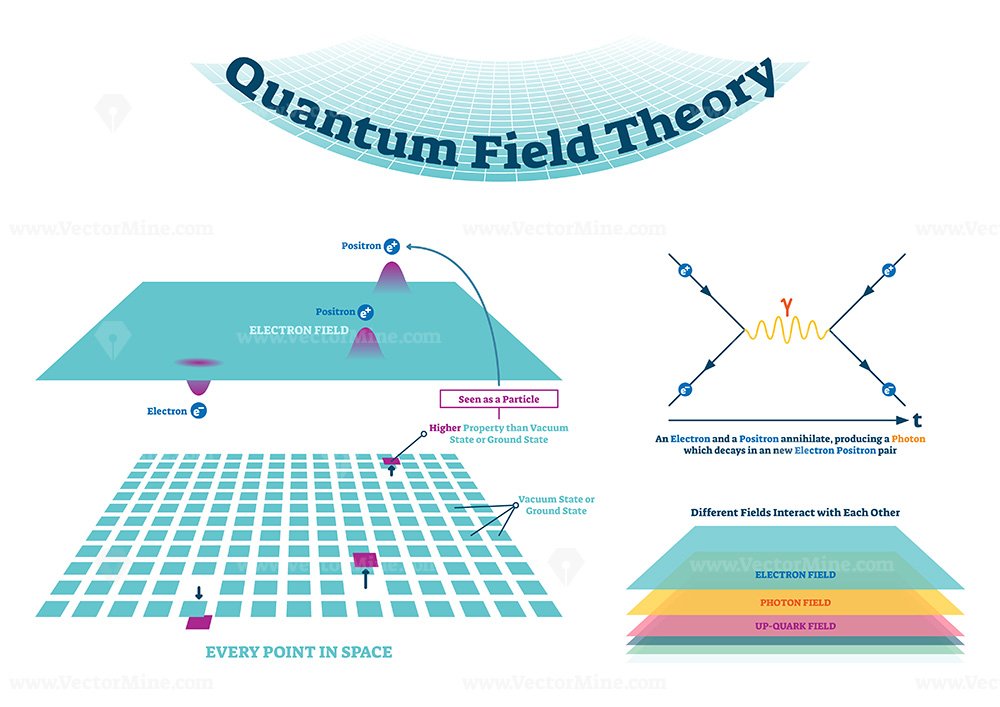
2. Ontological Stratification and Effective Autonomy
We distinguish three layers:
- Layer 0 – Physical Fields: Fundamental interactions described by QFT.
- Layer 1 – Cognitive Fields: Neural and informational dynamics.
- Layer 2 – Institutional Fields: Distributed normative structures governing collective behavior.
Institutional systems operate as effective field theories at Layer 2.
In physics, effective field theory allows macroscopic laws to remain valid independent of microscopic detail. Likewise, legal systems function independently of underlying particle physics while remaining physically instantiated.
Thus:
- Legal systems must be physically compatible.
- They need not be physically reducible.
This preserves both material grounding and structural autonomy.
3. Defining the Institutional Field
Let the institutional field I(x,t) represent the density and configuration of normative expectations across social spacetime.
The field consists of interacting components:
- Legitimacy density
- Trust distribution
- Authority coupling constants
- Enforcement intensity
- Procedural stability
Legal decisions are not isolated commands but perturbations within this field.
Institutional stability corresponds to equilibrium configurations of I(x,t).

4. Structural Correspondences with Quantum Field Theory
The following correspondences are structural, not reductive.
4.1 Symmetry and Legitimacy Conservation
In QFT, symmetry under transformation implies conservation laws via Noether’s theorem.
In institutional systems:
- Equality before the law corresponds to invariance under identity transformation.
- Procedural neutrality corresponds to invariance under status permutation.
When such symmetry breaks, legitimacy is not conserved.
Thus, legitimacy functions analogously to a conserved quantity within stable regimes.
4.2 Locality and Institutional Causality
QFT enforces locality through light-cone constraints.
Institutional systems display analogous causal boundaries:
- Jurisdictional limits
- Prohibition of retroactive punishment
- Procedural sequencing constraints
Normative effects cannot propagate arbitrarily; they are constrained by institutional “causal cones.”

4.3 Unitarity and Information Preservation
Unitarity ensures probability conservation.
Institutional unitarity corresponds to preservation of procedural coherence:
- Evidence must be accounted for.
- Decisions must remain reviewable.
- Processes must preserve informational continuity.
Violation produces institutional anomalies—crises of trust.
5. Renormalization and Institutional Scaling
Renormalization group (RG) flow in physics explains how microscopic parameters scale into macroscopic constants.
In institutional systems:
- Individual actions aggregate into structural constants (corruption rates, judicial independence, social trust).
- Normative micro-fluctuations can scale into macro-institutional shifts.
Institutional parameters are therefore scale-dependent but stable under renormalized equilibrium.
This concept explains why constitutional frameworks remain robust despite local disturbances.
6. Institutional Phase Transitions
Institutional systems exhibit phase behavior:
• Democratic ↔ authoritarian
• High-trust ↔ low-trust
• Stable ↔ collapsing regimes
These transitions occur when order parameters—such as aggregate legitimacy—cross critical thresholds.
Such phase transitions are not triggered by single legal acts but by systemic field reconfiguration.
Institutional collapse resembles symmetry breaking rather than rule violation.
7. Avoiding Category Error
The framework avoids reductionism.
Law is not physics.
Normativity cannot be derived from descriptive laws (avoiding the is–ought problem).
Instead, both domains share abstract structural principles characteristic of complex systems:
• Field distribution
• Conservation-like stability
• Symmetry regimes
• Critical transitions
The mapping is formal, not ontological.

8. Reframing the Original Question
The appropriate answer is not:
“Do legal principles conform to QFT?”
But:
“Do institutional systems exhibit field-like structural properties analogous to physical theories?”
They do.
Yet they remain autonomous effective structures.Institutional field theory exemplifies the paradigmatic strategy of borrowing the form of the field while preserving the soul of norms. It enables us to discuss the structure and dynamics of law using the language of modern physics and sociology, without falling into the reductionist trap of treating law as merely “another kind of physical field.”
9. Conclusion
Institutional Field Theory provides:
- A non-reductive bridge between physics and law.
- A framework for modeling institutional stability.
- A language for analyzing legitimacy crises as field perturbations.
- A structural account of normative autonomy.
Legal systems are embedded in physical reality but operate as emergent effective fields with their own conservation principles and phase dynamics.
Thus:
Physical compatibility is necessary.
Reduction is unnecessary.
Structural correspondence is illuminating.
Concept Map
Quantum Field Theory & Physics Foundations
An Introduction to Quantum Field Theory Peskin, M. E., & Schroeder, D. V. (1995). An Introduction to Quantum Field Theory. Westview Press.
Quantum Field Theory in a Nutshell Zee, A. (2010). Quantum Field Theory in a Nutshell (2nd ed.). Princeton University Press.
Scaling and Renormalization in Statistical Physics Cardy, J. (1996). Scaling and Renormalization in Statistical Physics. Cambridge University Press.
Emergence, Effective Theory, and Complex Systems
More Is Different Anderson, P. W. (1972). More is Different. Science, 177(4047), 393–396.
A Different Universe Laughlin, R. B. (2005). A Different Universe: Reinventing Physics from the Bottom Down. Basic Books.
Social Systems Luhmann, N. (1984). Social Systems. Stanford University Press.
Philosophy of Law & Normativity
The Concept of Law Hart, H. L. A. (1961). The Concept of Law. Oxford University Press.
Law’s Empire Dworkin, R. (1986). Law’s Empire. Harvard University Press.
Between Facts and Norms Habermas, J. (1992). Between Facts and Norms. MIT Press.
Systems Theory & Institutional Dynamics
Luhmann, N. (1984). Social Systems. Stanford University Press.
Waldrop, M. M. (1992). Complexity: The Emerging Science at the Edge of Order and Chaos. Simon & Schuster.
Fukuyama, F. (2011). The Origins of Political Order. Farrar, Straus and Giroux.
Institutional Field Theory
The New Institutionalism in Organizational Analysis (1991) Edited by Walter W. Powell and Paul J. DiMaggio University of Chicago Press
Institutions and Organizations: Ideas, Interests, and Identities By W. Richard Scott SAGE Publications
A Theory of Fields (2012) By Neil Fligstein and Doug McAdam Oxford University Press
SUPPLEMENT
The Field-Theoretic Perspective on the A Fortiori Principle: "Greater Includes the Lesser" (GILT)
From the standpoint of Institutional Field Theory (IFT), the principle of Greater Includes the Lesser (commonly known in legal Latin as a maiore ad minus) is more than a mere logical heuristic; it is a core mechanism for maintaining the stability of the Normative Field.
Why GILT is Categorical to the Institutional Field
We can analyze its significance through three primary dimensions:
1. Normative Conservation: Ensuring Symmetry and Legitimacy
In field theory, symmetries correspond to conservation laws. Within a legal system, GILT ensures the consistency of evaluative judgments.
• Logic: If the law explicitly regulates or prohibits a "lesser" harm (narrow power/minor injunction), it must logically encompass "greater" harms (broad power/major injunction).
• Significance: This prevents "vacuums" or "logical discontinuities" within the normative system. If a system permitted a "grave act" while prohibiting a "minor" one, the field’s symmetry would break, leading to a total loss of predictability and institutional legitimacy.
2. Renormalization and Scaling
Legal statutes are finite and discrete, yet the spectrum of human behavior is infinite and continuous.
• Mapping: GILT functions as a Renormalization Group (RG). It allows norms to scale across different "energy levels" (degrees of severity) without requiring the legislature to re-enact laws for every infinitesimal behavioral increment.
• Significance: It stabilizes the flow of power parameters, granting the legal system a non-reductive autonomy. The law does not need to exhaustively list every physical action; it sets critical normative boundaries, and the rest "flows" to fill the space via this principle.
3. Restricting Phase Transitions and Systemic Crises
Near a critical point, minor perturbations can trigger a phase transition (e.g., the collapse of the Rule of Law or a constitutional crisis).
• Mapping: By anchoring broad powers to narrow ones, GILT prevents the arbitrary expansion of power or the sudden "collapse" of interpretative frameworks.
• Significance: It defines causal locality, ensuring that legal reasoning remains confined within established normative boundaries. This acts as a "buffer zone," preventing the system from uncontrollable "implosion" when faced with extreme cases. Without this principle, a legal system becomes fragile: whenever a situation arises that is "graver" than current statutes, the system would paralyze due to a lack of direct provisions. GILT maintains maximum systemic stability with minimum informational input.
Richard Epstein’s Critique: Non-linear Collapse and Symmetry Breaking
Richard Epstein’s critique of the GILT principle reveals how normative fields can undergo non-linear collapse at specific boundaries, providing essential boundary conditions for IFT:
1. Non-linear Response: The response of a normative field to power is not strictly linear. One cannot simply assume that P_greater ⊃ P_lesser holds true across all scales.
2. Limits of Renormalization: When scaling via GILT, one must account for the fact that coupling constants (such as the sensitivity of civil liberties) change as the form of power shifts.
3. Critical Shielding: The legal system must establish "shielding mechanisms" to prevent "greater powers" from infiltrating protected private fields when they are decomposed into "lesser" conditional powers (the problem of unconstitutional conditions).
Core References for IFT and GILT
I. Logic and Structural Foundations
• Hans Kelsen, Pure Theory of Law (1967)
• Field Significance: Established the "Nomological Hierarchy" (Stufenbau), viewing norms as an emergent, non-physical field with autonomous layers. This provides the ontological basis for how power "flows" from higher to lower states.
II. The Idealized "Linear Scaling" Hypothesis
• Oliver Wendell Holmes, Dissenting Opinion in Western Union Telegraph Co. v. Kansas (1910)
• Field Significance: The most famous judicial articulation of GILT. Holmes argued that an absolute power to prohibit (high energy state) necessarily includes the power to impose conditions (low energy state). This represents the "ideal gas" state of normative symmetry.
III. Non-linear Corrections and Phase-Transition Critique
• Richard A. Epstein, "The Proper Scope of the 'Greater Includes the Lesser' Analysis," Virginia Law Review (1988)
• Field Significance: A seminal "disruptive" text. Epstein demonstrates that "lesser" powers (imposing conditions) can be more destructive to the field than "greater" powers (outright prohibition). This reveals spontaneous symmetry breaking at the boundary of fundamental rights.
IV. Field Boundaries and Dynamics
• Kathleen M. Sullivan, "Unconstitutional Conditions," Harvard Law Review (1989)
• Field Significance: A systematic taxonomy of how governments use "conditional exchanges" to bypass constitutional limits. This provides IFT with empirical cases of parameter drift, showing how normative values shift under institutional pressure.


留言
張貼留言