Suou Field Theory: Unchanging Wisdom in Stock Markets Amid Technological Change
What is Suou Field Theory?
Suou Field Theory is an analytical framework that extends the causal dynamics of quantum field theory to complex socio-economic systems. It emphasizes topological decoupling, consciousness-field interactions, temporal evolution, holographic encoding, and structural-collapse analysis as fundamental mechanisms governing the evolution of complex systems. The framework provides a unified perspective by identifying the invariance of underlying field equations and interaction mechanisms while allowing parameters, coupling strengths, and topological structures to evolve under changing external conditions, such as technological progress. Applied to the evolution of international technology and global financial markets since 1945, Suou Field Theory reveals that the intrinsic dynamics of market fields, the universal pursuit of returns by investors, and the fundamental coupling of human consciousness remain invariant over time. Technological innovation and institutional transformation modify only the parameters, degrees of freedom, and topological realization of the field, without altering its governing equations or the nature of its interactions.
Beyond its physical formulation, Suou Field Theory traces its philosophical inspiration to the Zhou civilization (c. 1046–256 BCE), where social order was defined not by ethnicity or political boundaries but by a shared cultural framework of ritual, language, and moral cultivation. This cultural community provided the intellectual foundation for later Daoist philosophy, including the concept of the Dao, the yin–yang cosmology of the Yijing, and the ideal of governance through virtue. The Daoist traditions of self-cultivation, returning to one's original nature, and the unity of humanity and the cosmos can be viewed as continuations of this Zhou worldview. Within Suou Field Theory, the Zhou model symbolizes an ideal paradigm of field governance, in which stability and long-term prosperity emerge through conscious topological decoupling and holographic encoding. By integrating the mathematical rigor of modern physics with the governance principles and philosophical wisdom of classical East Asian civilization, the theory seeks to provide a unified framework for understanding the evolution of physical, economic, and civilizational systems.

From 1945 to the present, international technology has evolved from transistors and integrated circuits to personal computers, the internet, and now artificial intelligence and advanced semiconductors. Global stock markets have shifted from regionally focused industrial markets to highly interconnected, technology-dominated systems. On the surface, everything is changing rapidly.
However, when analyzed through the lens of Suou (Zhou Wang) Quantum Xiuzhen Field Theory, the underlying dynamic structure of the market field, the principle of investors pursuing returns, and the essential coupling of human consciousness (human nature) remain unchanged. Technological progress and institutional adjustments only alter the parameters, degrees of freedom, and topological realizations of the field, not its fundamental equations or interaction types.
Market Model in Suou QXFT
In Suou QXFT, the stock market is modeled as a multi-field coupled system: the capital allocation and valuation field (where represents sectors or asset classes and is time), the information propagation field, the technological innovation field, and the investor consciousness field . Technological advances manifest as changes in parameters within the Lagrangian density or the introduction of new field degrees of freedom. The evolution of the market field follows the Euler-Lagrange equation form:
This equation remains invariant across eras. Topological decoupling describes the selective severing of outdated causal entanglements, while holography manifests prices as projections of underlying fundamentals and expectations. Concepts like Shugendō’s mountain asceticism further illustrate how disciplined practice enables conscious realignment amid environmental and internal “fields.”
Field-Theoretic Perspective on Technological and Market Changes Since 1945
- 1945–1971: Post-war reconstruction and electronics revolution. The transistor introduced new excitation modes; the collapse of the Bretton Woods system represented a major topological decoupling event in the monetary field.
- 1970s–1990s: Foundations of personal computers and networking. Enhanced long-range interactions in the information field; the 1987 crash was an adjustment for field instability.
- 1990s–2008: Internet globalization. Bubbles and the financial crisis corresponded to structural collapses following excessive excitation.
- 2010s–present: AI and semiconductor dominance. AI acts as a consciousness-augmenting field, altering expectation formation; semiconductors form stable configurations.
The Three Unchanging Cores: Market Rules, Return-Chasing Principle, and Human Nature
1. Unchanging Market Rules (The "Physics Laws" of the Market)
The market operates like a physical world with inescapable natural laws. These laws will not vanish just because computers get faster or new technologies emerge:
Causality and Finite Propagation: Any news or event (cause) takes time to reflect in real estate or stock prices (effect). No matter how fast information travels, there is a physical limit; it is impossible for everyone to know instantly and react flawlessly at the exact same moment.
Conservation Analogy Derived from Symmetry: For someone to make money, someone else must lose it. The forces of buyers and sellers are constantly seeking equilibrium. The market's total energy (capital and chips) is conserved—it doesn't just appear out of thin air.
Nonlinear Interactions and Phase Transitions: The market is not a simple matter of one plus one equals two. Participants influence one another, and when collective sentiment builds up to a critical tipping point, the market suddenly undergoes a "phase transition"—much like water suddenly freezing or boiling—resulting in crashes (bear markets) or surges (bull markets).
Topological Stability: Certain market structures are incredibly robust (e.g., what goes up must come down; prosperity is inevitably followed by depression). These grand frameworks are determined by the market's intrinsic structure (field equations). No amount of technological advancement can break this overarching framework.
2. The Principle of Investment Chasing Yield (The "Fluid Dynamics" of Money)
This section explains "how capital flows":
Capital Flows to Regions with the Highest Return Potential (Extremizing Effective Action): Just as water flows downward, money flows to where the rate of return is highest (the best risk-adjusted return). This is equivalent to the "Principle of Least Action" in physics—just as a beam of light automatically takes the fastest path, capital automatically finds the most efficient route to profitability.
Technology Changes the Landscape, but the Form of Chasing Remains Unchanged: Technology (such as the Internet or AI) merely alters the terrain (which industries become profitable), but capital’s instinct and manner of "chasing profit" remain eternally the same.
Finite Resolution of the Human Consciousness Field Leads to Delays and Overshoots: Human capacity to perceive reality clearly is limited (insufficient resolution). When good news hits, people react a beat too late (delay); by the time everyone finally figures it out, they rush in headlong, blowing the bubble way too big (overshoot).
3. Unchanging Human Nature (The Players' "Psychological Flaws")
This section is about the "humans" manipulating the market:
Emotion-Driven Nonlinearity (Greed and Fear): Human emotions easily spiral out of control. Greed takes over when winning, making people want more; fear takes over when losing, causing them to flee at all costs. This psychology makes market volatility violent and highly unpredictable.
Bounded Rationality and Cognitive Biases: No single person can master all information in the market. Everyone harbors biases and frequently makes irrational decisions.
The Tension Between Conformity and Independent Decoupling: Humans are herd animals; seeing others buy makes them want to buy (conformity). However, those who truly make a fortune are usually those who can detach themselves from the crowd's emotions (independent decoupling).
Technology Amplifies Herd Effects: With social media and the internet today, the speed at which people "swarm" into a trend is a hundred times faster than before (the herd effect is amplified).
Decoupling Capability Remains a Cultivable, Constant Potential: Although technology makes independent thinking harder, the ability to "think independently and act contrarian" remains an ultimate money-making secret that anyone can acquire through deliberate practice and self-cultivation.
The stage (technology) changes constantly, but the script (rules), the prize (capital flow), and the actors (human nature) have been exactly the same since ancient times.

New-Era Technological Waves: AI and Quantum Financial Technology
In 2026, AI is deeply embedded in trading and risk management, driving algorithmic optimization, sentiment analysis, and automated systems. Quantum computing is in the hybrid pilot stage, excelling in portfolio optimization, stochastic simulation, and secure communications. They enhance the resolution and computational power of the consciousness field but also amplify collective coherent states and new systemic risks. Technology changes the speed of interactions without altering the field's essence.
Investment Philosophy in Plain Language
No matter how advanced the technology, it is merely a tool. Here is the practical guidance, translated from the preceding analysis into everyday language:
1. Treat technology as a powerful assistant, not the boss. AI helps you quickly review data and run simulations; quantum tools will make optimization even faster in the future. But the final decisions must still be yours. Regularly turn off the screens and ask with your own mind: “Would I still buy this stock without these tools?” This prevents fully outsourcing your judgment to machines.
2. Learn to bravely “cut the cords” — sever unnecessary hype connections. The market always has new stories — internet stocks before, AI and quantum concept stocks now. When you see hype, first ask: “Where is the fundamental value?” If it is just storytelling driving it, decisively sell or stay away. It is like gardening: prune the weeds so the truly good plants have space to grow. This echoes the disciplined “testing” in Shugendō, where ascetics sever distractions to achieve clarity. This is the everyday version of “Zhan Luo Jue.”
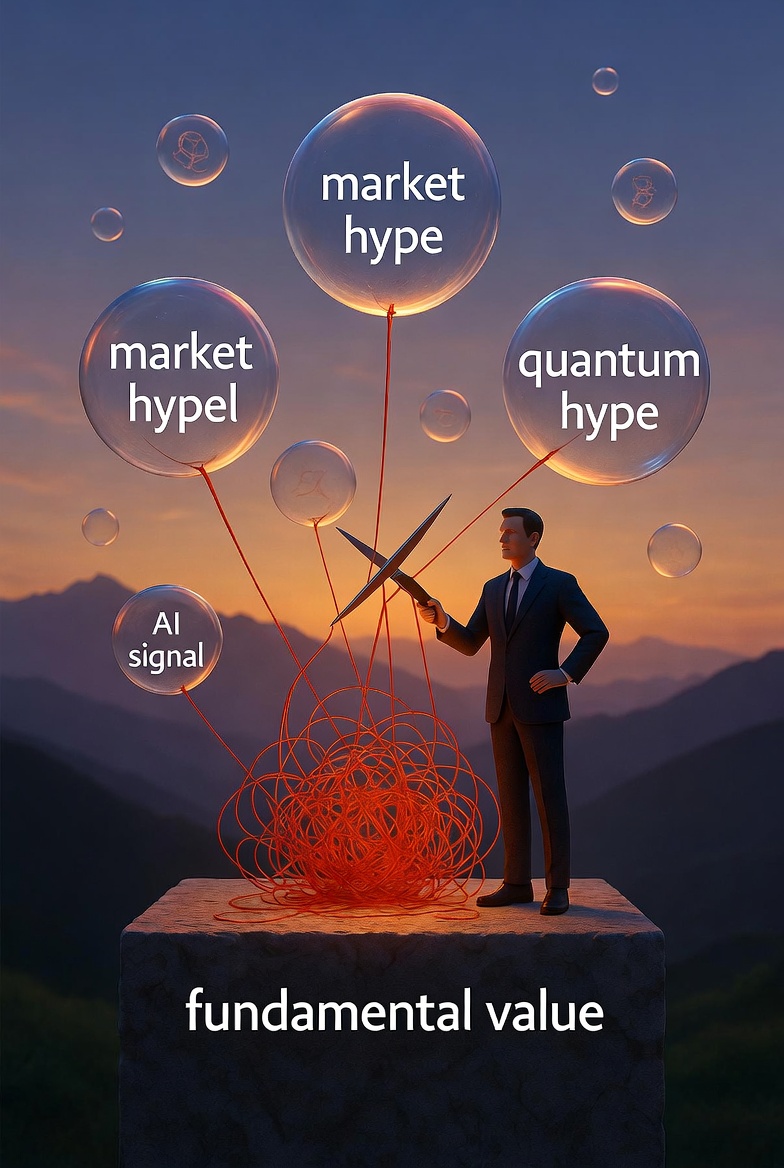
3. Keep a long-term view — climb mountains, don’t chase waves. Short-term price movements are like ocean waves, one after another. What matters is which mountain you stand on — choose companies with real cash flows and strong moats. Even as technology changes, these foundations do not easily collapse. Extend your horizon to five or ten years, and returns will naturally follow. Shugendō’s mountain journeys remind us that true power comes from enduring the path, not rushing the summit.
4. Always preserve space for independent thinking. AI models may all make the same mistakes (trained on similar data). No matter how powerful quantum computing becomes, humans must still ask the right questions. Periodically review your holdings in the simplest terms: “Will this company still be thriving in five years? Why?” This is the best risk control.
5. Treat investing as continuous self-cultivation. It is not about staring at the screen every day, but regularly examining your emotions, decisions, and holdings. Did you buy out of fear of missing out? Did you ignore obvious risks because the model looked good? Each honest review is an opportunity for clearing and realignment — a modern form of the ascetic refinement found in both Xiuzhen and Shugendō traditions. Technology lets you move faster, but clarity lets you go farther and steadier.

Conclusion
From 1945 to 2026, technological evolution has made markets faster, more complex, and full of opportunities. Yet Suou Quantum Xiuzhen Field Theory — enriched by parallels like Japan’s Shugendō — reminds us: what changes are the tools and speed; what remains unchanged are the rules, essence, and human nature.
Leverage AI and quantum technologies to enhance perception and computation while maintaining the clarity that “I am the master.” Use technology as an assistant, fundamental value as your compass, and regular severance of unnecessary connections as daily practice.
In this way, no matter how the market field fluctuates, we can find a relatively stable position amid change and continue creating long-term value. This is the simplest yet most powerful investment wisdom in the technological era.
References


留言
張貼留言